
Your whole custody stack, through prompts.
Point Claude, or any coding agent, at the Salt SDK. It can create automated cosigners, deploy them to your own infrastructure, run key ceremonies with your team, work with your policies and even build a whole fintech on top. You and your cosigners hold every key share.
See the prompt
Read https://salt.space/llms.txt, then help me set up Salt on testnet: a treasury my CFO and I can both propose from, with a Robo Guardian in our AWS account, that only pays our allow-listed suppliers. Walk me through it step by step with the Salt SDK.
Your own signing quorum. Backed up onchain.
Deploy self-hosted cosigners (Robo Guardians) with a prompt or a click, then stand up a small, federated signing quorum in minutes. Every key share is encrypted and stored in a smart contract, ready to pull down on any device. We never hold a piece.
Chat to your policy layer.
Add and edit your guardrails just by asking, or find out why something was blocked.
Why was the trading bot’s 75,000 USDC transfer to Kraken blocked?
It breached the daily cap.
It would have taken today’s total to 87,400 USDC, so the guardian didn’t cosign. I can draft a higher cap for an owner to review and sign.
auditor@harlow pull tx 0x91e…b04f
A policy snapshot on every transaction
The exact policies each transaction passed, kept for good.
Policies anyone can verify
Owner-signed, and checkable by your auditors, with or without our SDK.
Human in the loop
Named approvers sign off before cosigners sign.
Bring your compliance provider
Run Travel Rule and screening checks first, then attach your provider’s reference to the transaction.
Salt is self-custody infrastructure, not a custodian. Your compliance obligations stay with you, and Salt gives you the evidence to meet them.
Five ways to put Salt to work.
Set it up with a prompt, or use our freely accessible app.
Point your AI agent at the Salt SDK and set up accounts and policies with a prompt. Soon, you’ll also be able to do it all yourself in the Salt web app.
- Daily caps and allow-lists on every account
- Payments cosigned by your self-hosted cosigners (Robo Guardians)
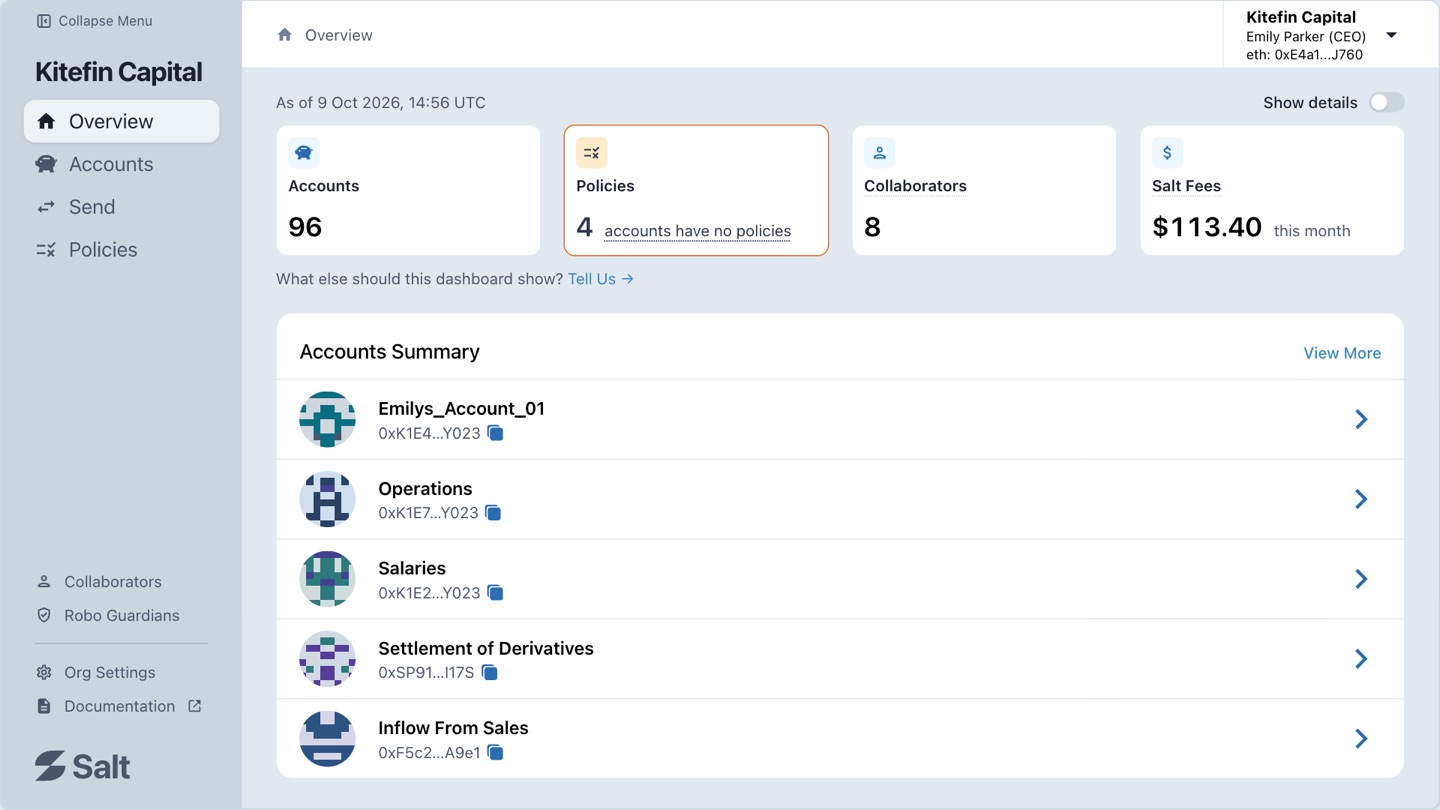
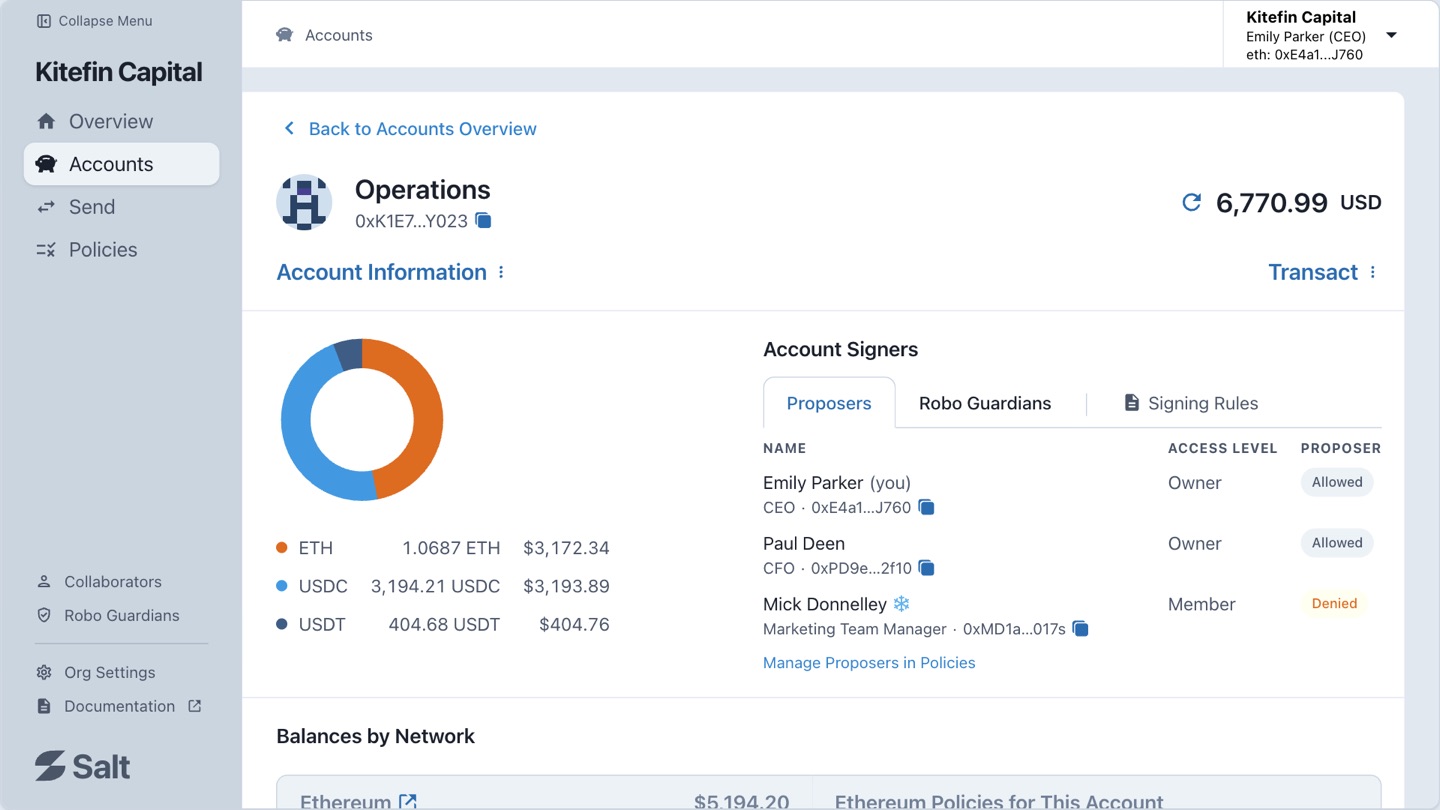
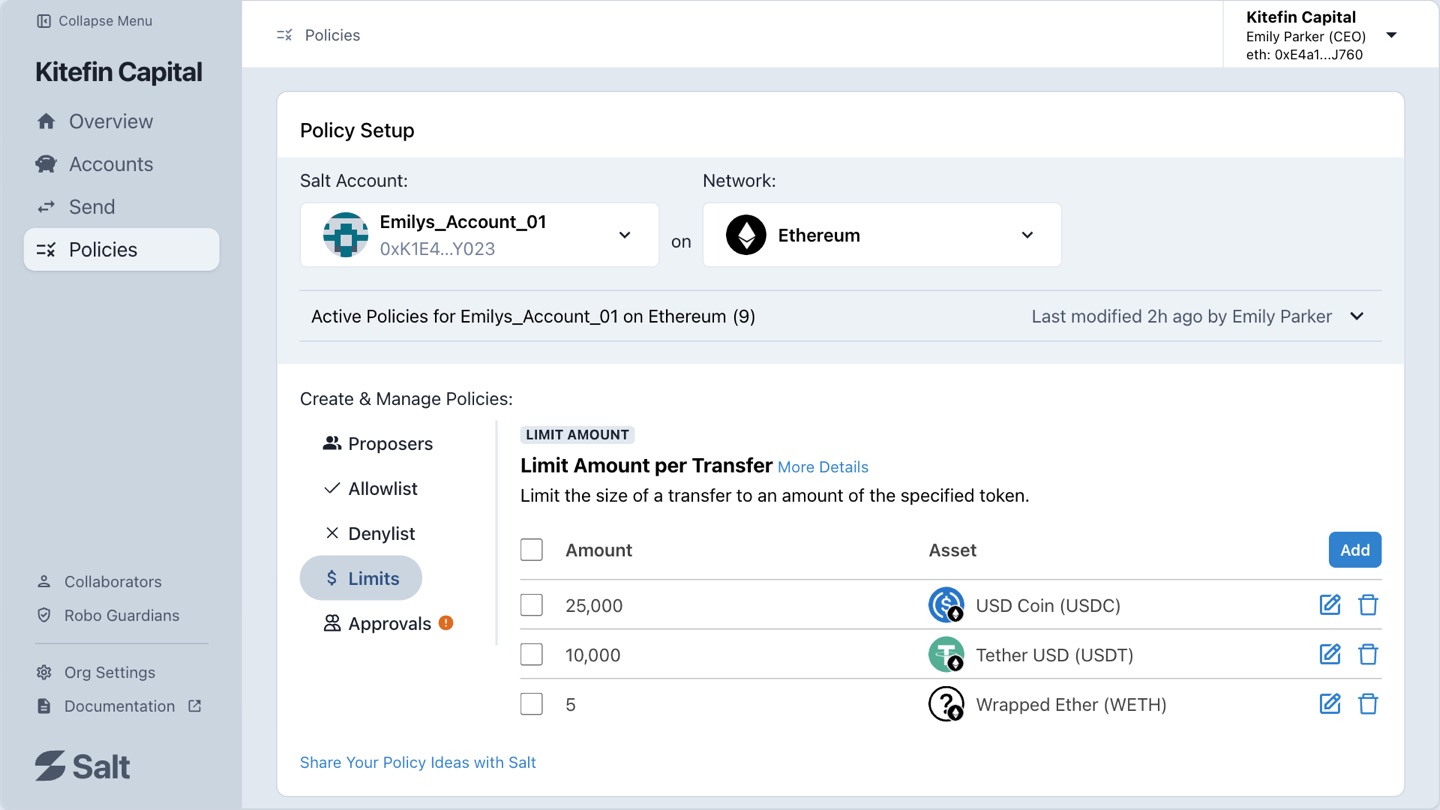
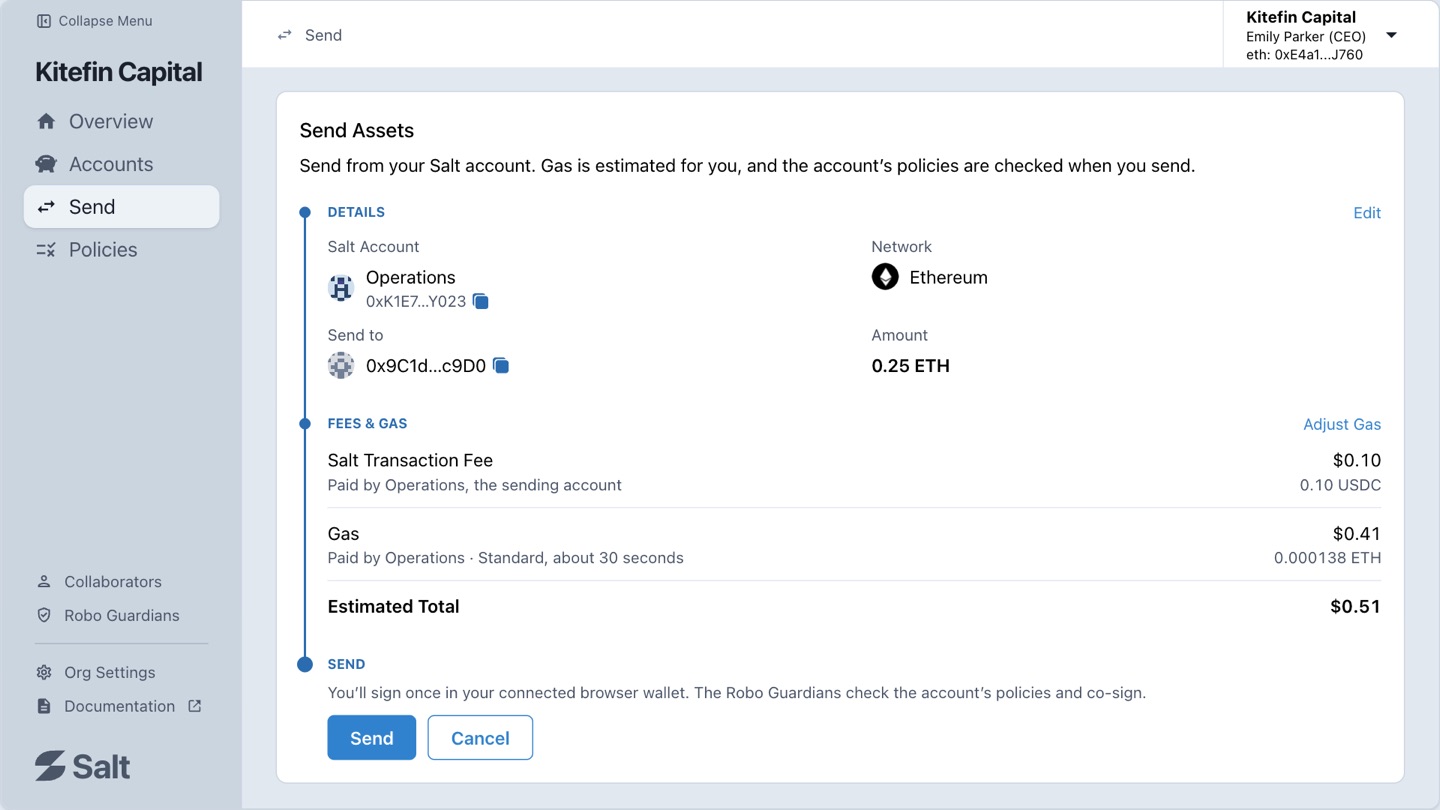
Run strategies around the clock, inside hard limits.
Your bots work DeFi and rebalance across exchanges 24/7. Policies written down to the smart contract keep every move inside the mandate, even at 3am.
- Rules down to the contract call: which function, which values
- Capital moves between exchanges only to approved deposit addresses
- Self-hosted cosigners (Robo Guardians) sign 24/7, so no one is on call
- Every move on the record for your administrator
- Onchain 10.0M
- Aave 6.0M
- Binance 6.0M
- Coinbase 4.0M
- OKX 4.0M
- Allow-list
Aave, Uniswap, 3 exchange deposit addresses - Aave
borrow(amount ≤ 2,000,000) - Uniswap
swap(recipient = this account) - Daily cap
5,000,000 leaving the account
- Borrow 1.8M USDT from Aave 03:13:41Cosigned
- Borrow 4.0M USDT from Aave over the 2M limitBlocked
Offer SMAs without taking custody.
Your clients keep their keys and set the rules. You, or your agents, trade inside them.
- Trade approved venues without waiting on client sign-off
- Trades above an agreed size wait for the client to approve
- Withdrawals only to addresses the client approves
- Every trade on the record, ready for client reporting
- Supply 500,000 USDC approved lending marketSigned
- Withdraw 1,000,000 USDC to a new addressBlocked
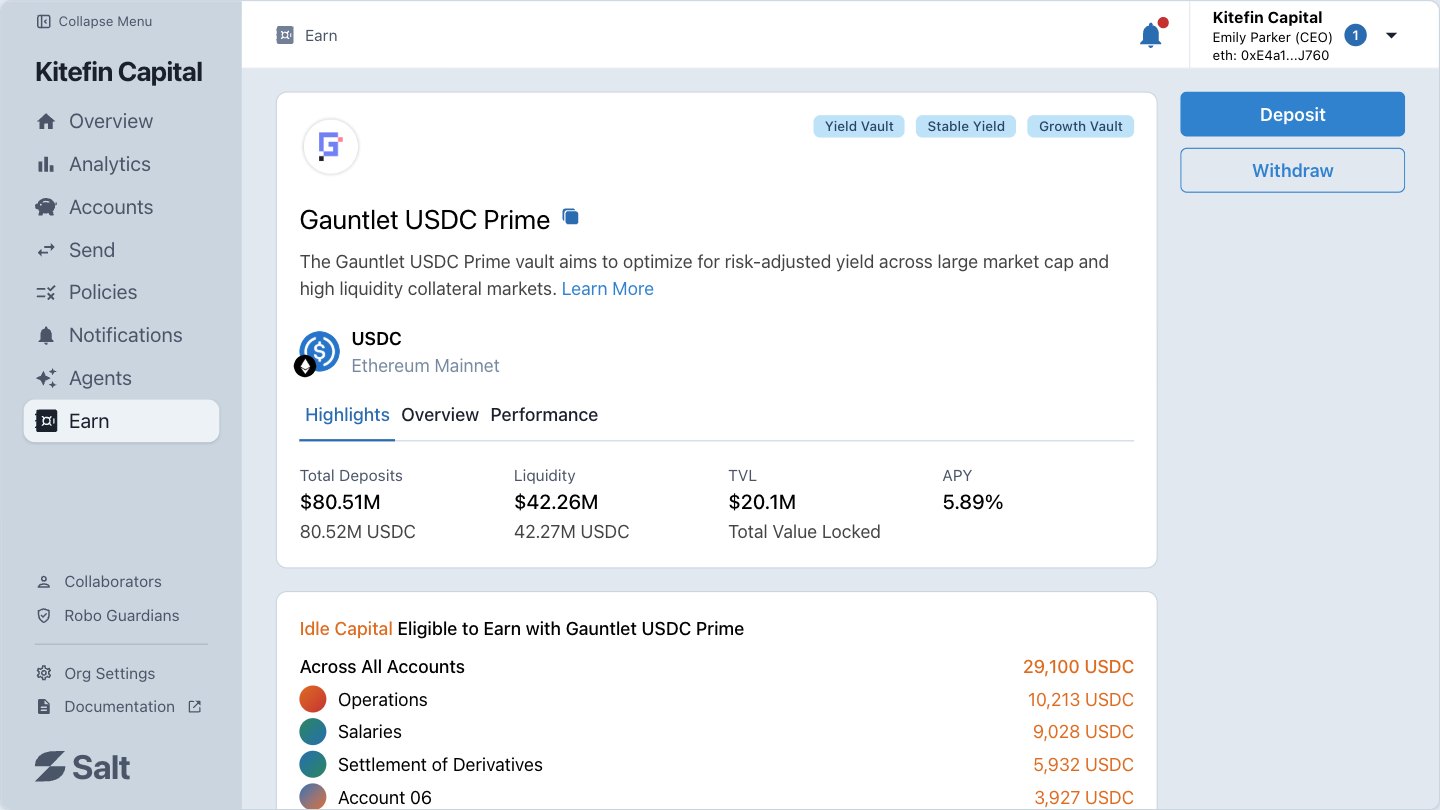
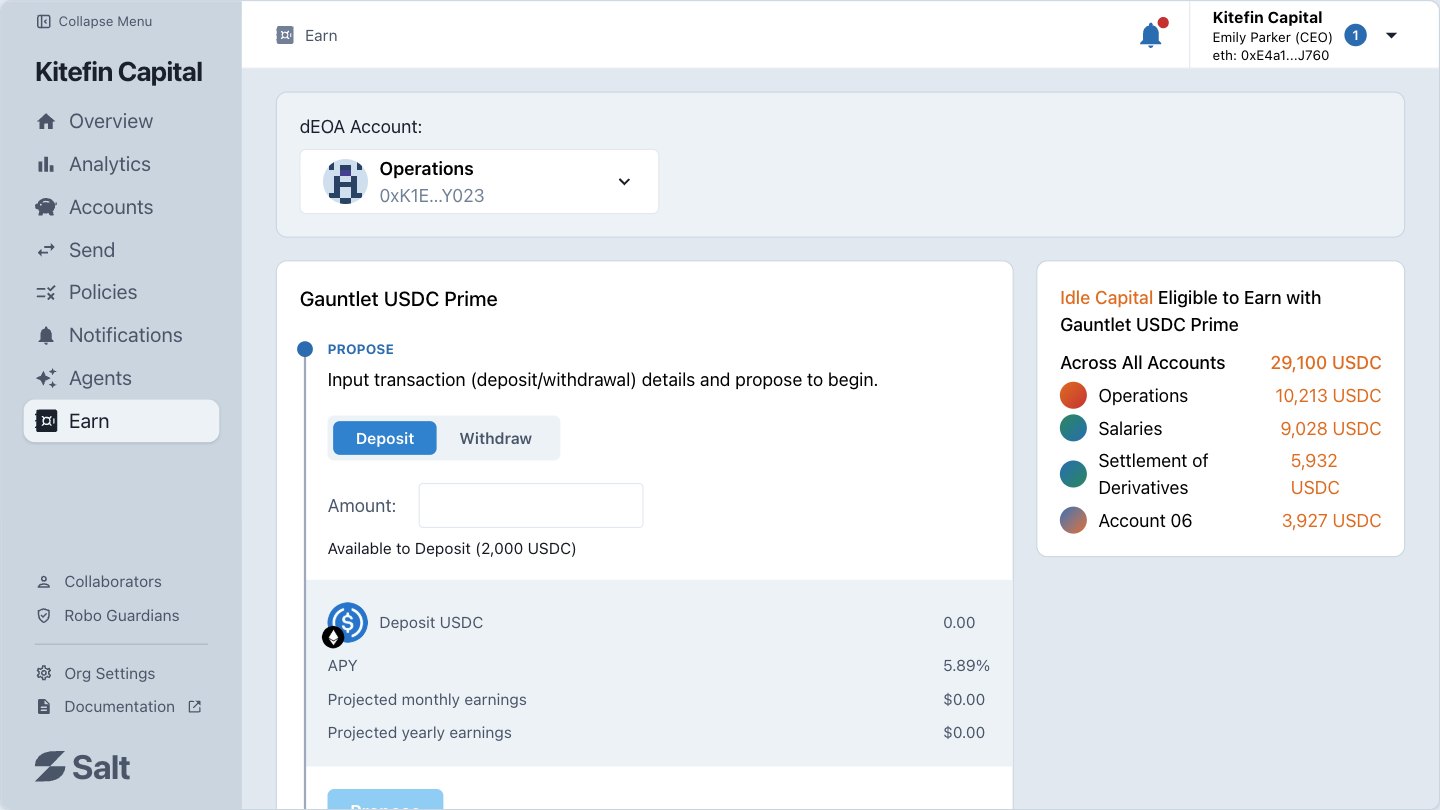
Earn, curated by Salt.
Idle cash starts earning from the app you already run your treasury in, and never leaves your control. Building a product? Exclusive vault drops come straight through the Salt SDK.
- Idle capital flagged across every account
- Exclusive vault drops, through the Salt SDK
- Wire your fintech to offer each new vault to your customers
- Any DeFi protocol from code, inside your policies
 vault launching in Q1 2027
Your brand on top. Salt underneath.
Ship a wallet, a savings app or a payments product without building custody from scratch. You design what customers see. Salt runs the keys, policies and signing beneath it.
- Every customer in an account of their own
- Limits and allow-lists on every customer account
- Sponsor your customers’ Salt fees
- Built on our SDK, so your agent can wire it up

Priced like software, not like custody.
Flat fees in USDC, the same whether you move $1 or $1bn. No AUM or custody fees, and no minimum spend.
Then as many more accounts as you need on the same quorum, free.
Flat, whether you move $1 or $1bn.
The same flat fees, on your own infrastructure.
How self-hosting worksWhy it costs so little
Your encrypted key shares live in a smart contract on Arbitrum, not on our servers. No key storage to run means no custody fee to pass on.
- Paid in USDC over x402, by a person or an agent
- Building a fintech? Sponsor fees for your customers
- No per-seat fees for your team
Run Salt inside your own perimeter.
Self-host the coordination layer at no extra cost. Same SDK, same fees.
- Policies checked on your own servers, before anything is signed
- Signing coordinated over your own WebSocket server
- Named approvers on the transactions that need a human
- Auditors see everything and can't sign
- Your compliance provider's checks on every transaction
The automation era of finance starts with one prompt.
Self-serve and permissionless. EVM networks today, with Bitcoin and Solana in Q1 2027.
npm install salt-sdk viem- Works with Claude or any coding agent
- Sign in with your wallet. No API keys
- Agents pay their own fees over x402