
Delightful self‑custody.
Salt is a complete, machine-native platform for holding, controlling and moving digital assets. You and your cosigners hold every key share; Salt holds no key material.
- Self-serve set-up in 10 minutes
- No sales calls
- Flat, incremental fees. No AUM charges.
- EVM today. Bitcoin & Solana in Q1 2027
Design principles
- SDK first Available nowEverything Salt does is available in the TypeScript SDK today, from organisations and accounts to policies and transactions. Start with
npm install salt-sdk viem. - Your wallet is your identityNo usernames or passwords. You sign in with Ethereum (SIWE), and your address carries your role in each organisation.
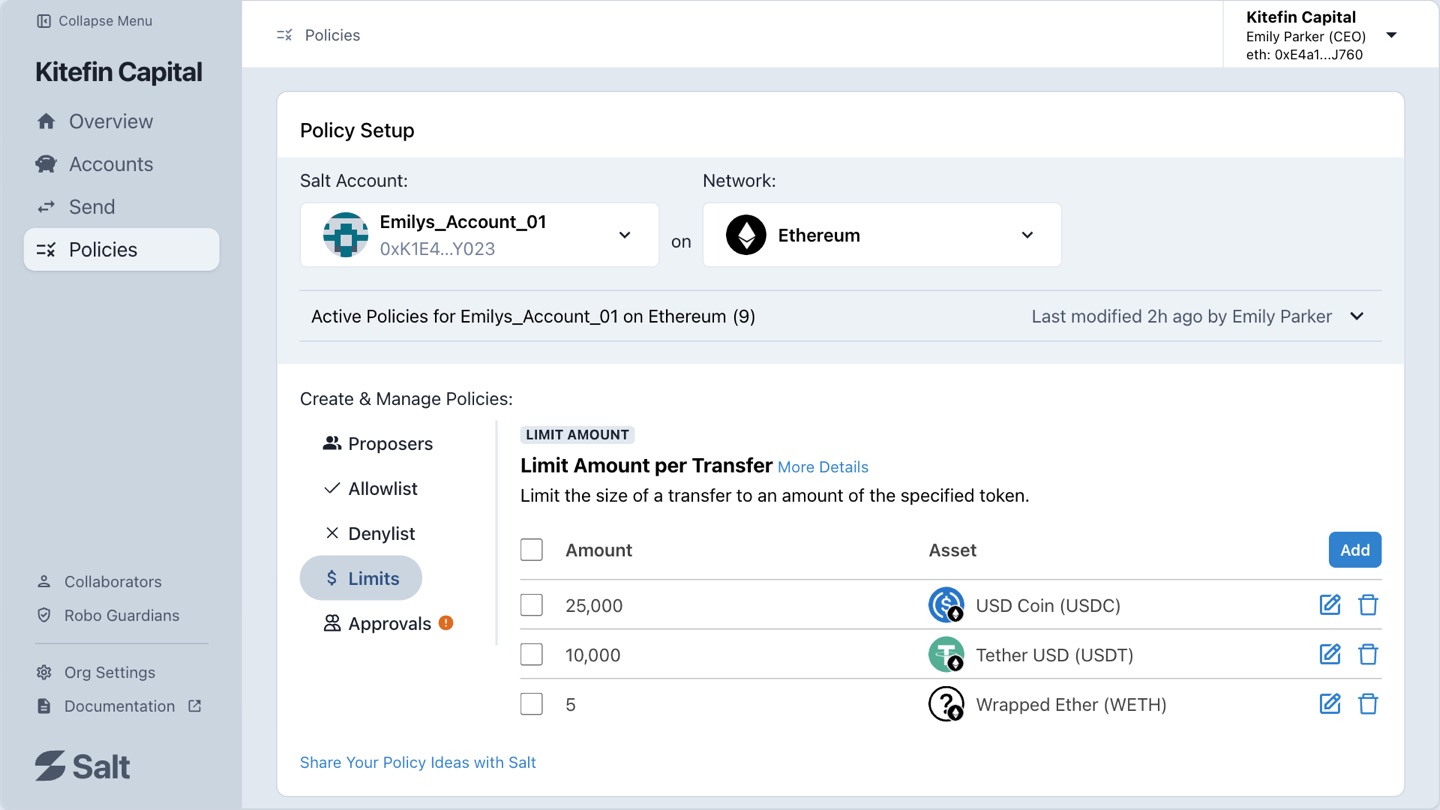
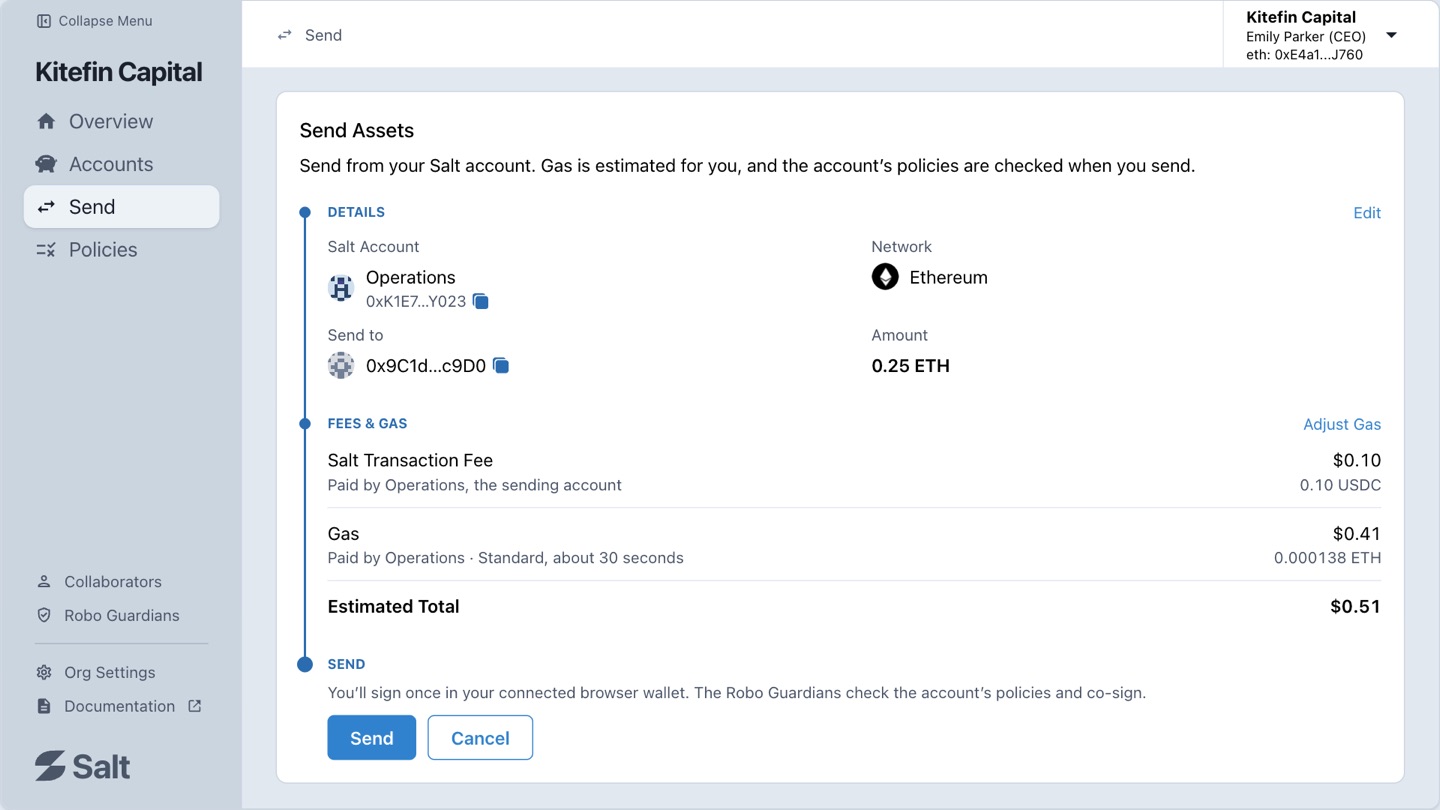
- Risk management on every transactionEvery transaction is checked against the account's policies before cosigners add their signature.
- You choose where your cosigners runSalt will never hold your key material. We make it easy to host your own automated cosigners (Robo Guardians): self-deploy onto an Ubuntu or Debian server, or 1-click deploy on AWS. You also decide when they're online.
- Recoverable if Salt goes darkYour assets don't depend on Salt being online. If Salt disappears, your signers can still move your assets.
- Built on open standardsSIWE for sign-in, EIP-712 typed signatures, and x402 for small USDC fees with no gas for the payer.
Automated signing
Focus on what matters while your workflows run around the clock using Salt's policy-protected signing ceremonies.
What makes Salt different
An open, machine-native MPC platform. No gates such as API keys or sign-up forms: any entity with an EVM wallet can sign in and pay its own fees over x402.
Salt coordinates the ceremonies and checks policies, but it holds no part of your keys.
Salt stays portable and open by storing your encrypted key shares in a smart contract. This allows you to create and operate EVM, Bitcoin and Solana threshold accounts from any device.
Everything in one system
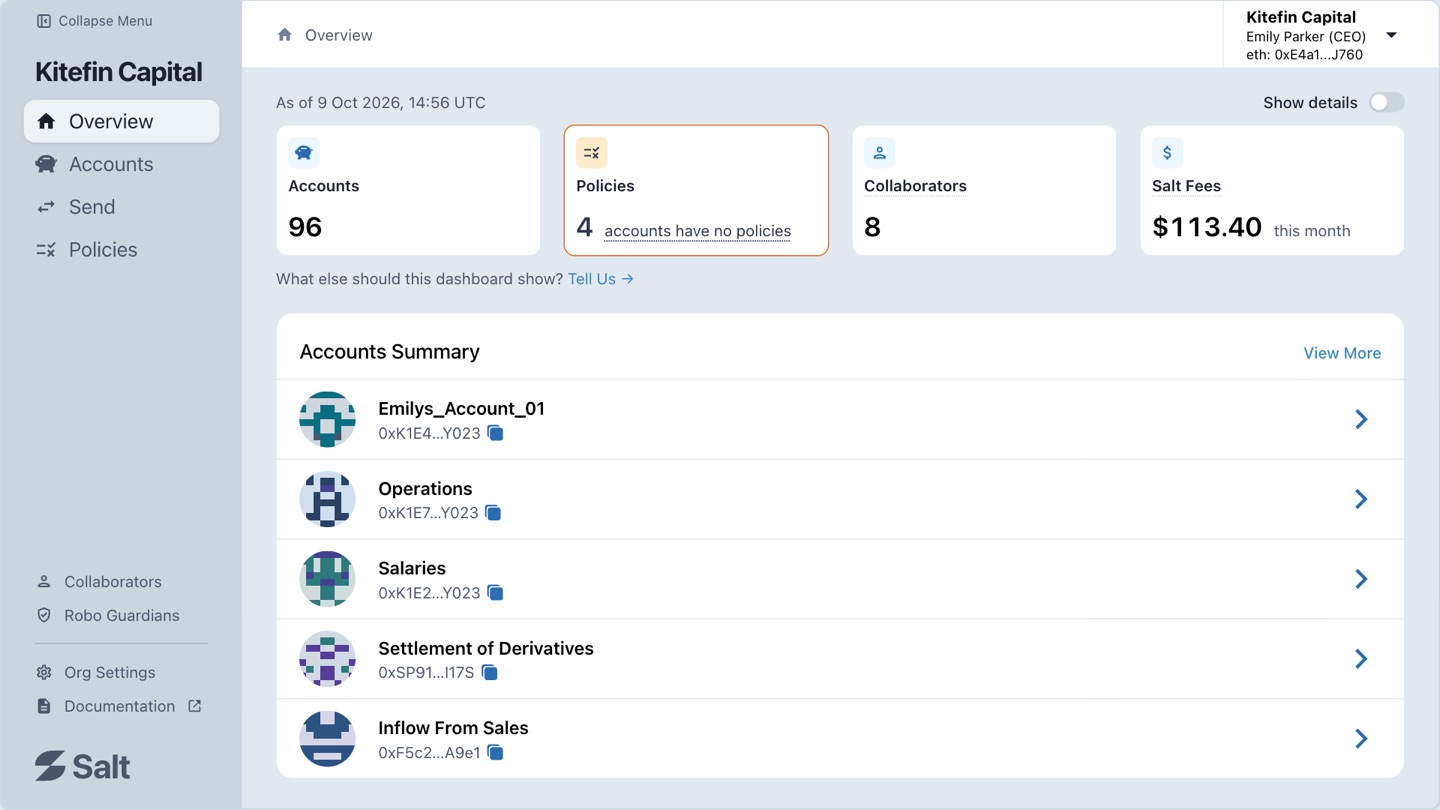
- OrganisationOwners, members and delegates, each identified by their wallet
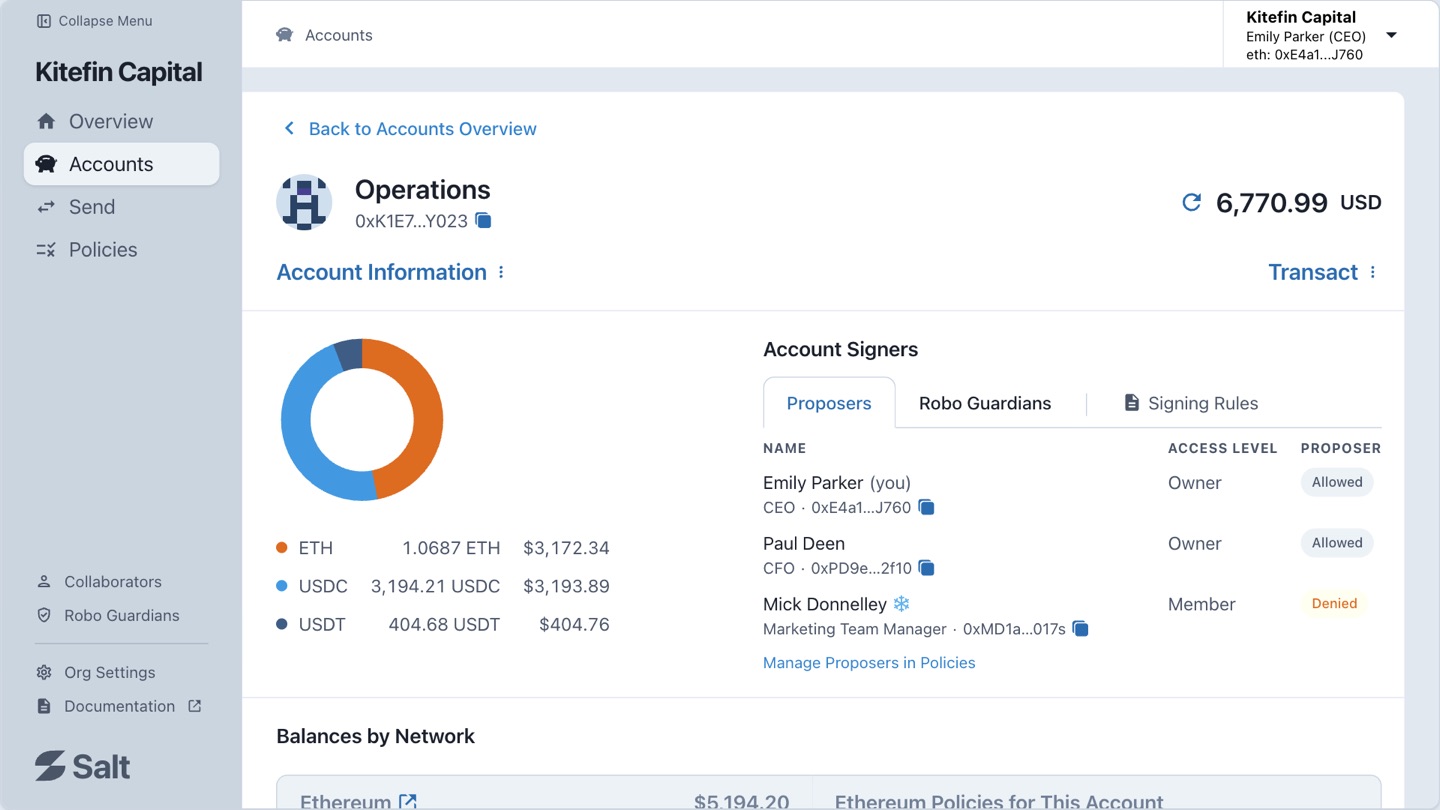
- AccountsThreshold MPC accounts for EVM, with Bitcoin & Solana in Q1 2027
- CosignersYour devices and Robo Guardians
- PoliciesRules every transaction must pass, signed by you
- TransactionsAny proposer signs; cosigners sign once it passes policy
- RecoveryEncrypted key share backups on Arbitrum
Who is Salt for?
- Organisations and treasury teamsCompany funds can be held under shared control, with the organisation's own policies and automated cosigners, without a third-party custodian.
- Pro tradersThe SDK supports programmatic trading, redemption management and separately managed accounts (SMAs), all governed by a policy layer that supports granular DeFi policies.
- Developers and fintechsMPC accounts and child accounts can be embedded into a product for its users. Tenant data separation keeps each fintech's users apart, and you can build your own front end on top.
- AI agents and automated systemsAn agent can join an organisation as a delegate and propose transactions alongside people. Each proposal is checked against the account's policies.
Pricing
- Flat fees, whether you send $1 or $1bn
- No AUM or custody fees, and no minimum spend
- All supported chains included, paid in USDC over x402
Security
- Salt's MPC is built on cryptography from Silence Laboratories, which has been independently audited by Trail of Bits, Cure53, HashCloak and Secfault Security.
- Each signer holds one key share. Once the threshold is met, the shares produce a single standard signature. Onchain, it's a regular account (EOA), not a multisig.
- You can recover an account yourself, without Salt, using an open-source recovery app.
- Salt asks your wallet only for signatures, never for the key itself. Signing happens locally on your machine.
- Hardware wallets work as signers, so your key can stay on a Ledger.
- Each of your key shares is backed up to a smart contract on Arbitrum, encrypted to your wallet.
- Every policy change is signed by an owner's wallet.
Links
- Website
- salt.space
- Docs
- docs.salt.space
- SDK reference
- developer.salt.space/sdk
- npm
- npmjs.com/package/salt-sdk
- Web app
- app.salt.space (coming soon)
- Terms
- salt.space/terms/app
Example app
salt-fi
A vibe coded, open-source example of building on the Salt SDK: a guided terminal app that sets up an organisation, cosigners, an account and a first policy. It's maintained independently, isn't an official Salt product and hasn't been audited, so use it on testnet.
- GitHub
- github.com/salt-space/salt-fi
- Field guide
- salt-space.github.io/salt-fi/field-guide, a walkthrough for setting up salt-fi